Can You Go to Cosmetology School with a GED? Yes — State Guide
Yes — a GED is widely accepted at cosmetology, barber, esthetician, and nail tech schools. Beauty licensing is state-by-state: 200-2,100 training hours, $1,500-$20,000 cost, Pell Grants cover most. Read the rules before you apply.
Yes. You can go to cosmetology, barber, esthetician, or nail tech school with a GED in all 50 US states. Most state boards require a high school diploma or GED for school admission and the licensing exam. Training hours range from 200 (nails) to 2,100 (full cosmetology). Pell Grants cover most tuition. Verify rules with your state board before enrolling.
Last reviewed
You may have heard that a high school diploma is required to pursue your dreams in the beauty industry. If you did not finish high school, you still have a path forward.
A GED is widely accepted as a high school equivalent across the US beauty industry, but licensing rules are set by state boards. The school you choose may also have its own admission requirements. The GED test program is administered in more than 90 countries, virtually all colleges and employers accept the GED credential, and 150,000 GED graduates earn their credentials in the US each year.
Before you apply, you need to know what your state requires, what your school expects, and how licensing works. This guide breaks down how to move from GED prep to beauty school with fewer surprises.
Quick Answer About GED and Cosmetology
A GED can qualify you for cosmetology school, barber school, esthetician school, and many nail technician programs. The rule is not federal. Beauty licensing is handled by state boards, so each state decides the education requirement, training hours, exam process, and renewal rules.
That is why "do you need a GED for cosmetology school" should be answered before you apply, not after you pay an application fee.
BLS says barbers, hairstylists, and cosmetologists usually need to complete a state-approved barber or cosmetology program and pass a licensing exam. Admission requirements vary by state, and some states require a high school diploma or equivalent.
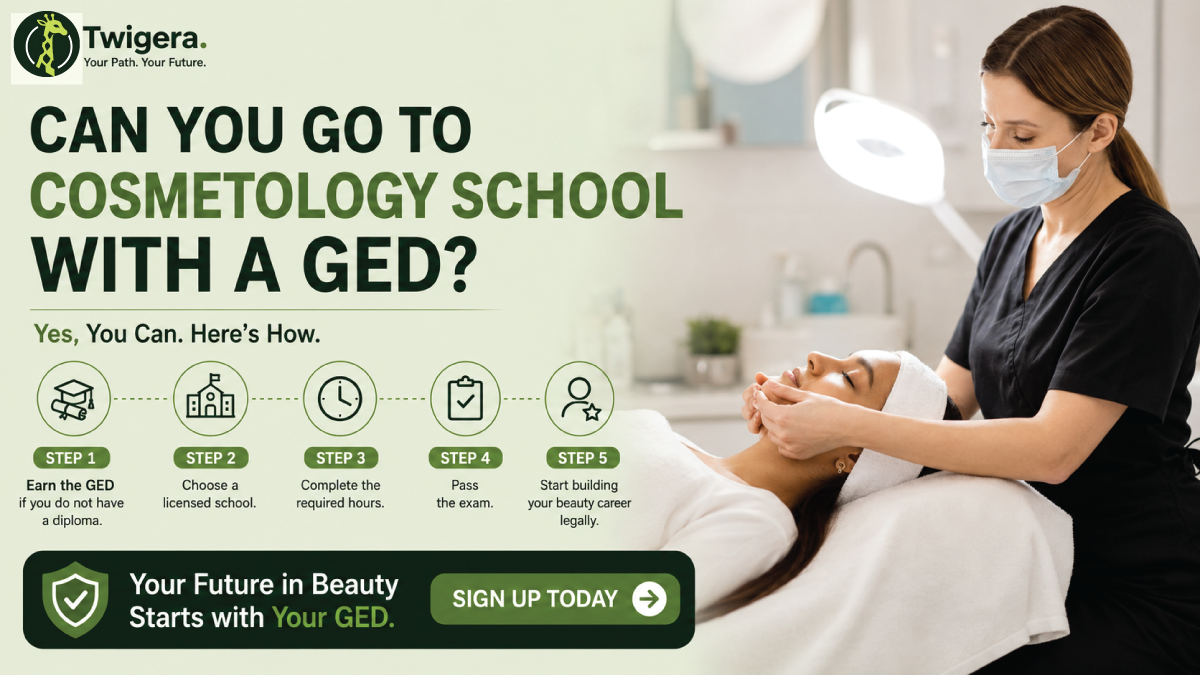
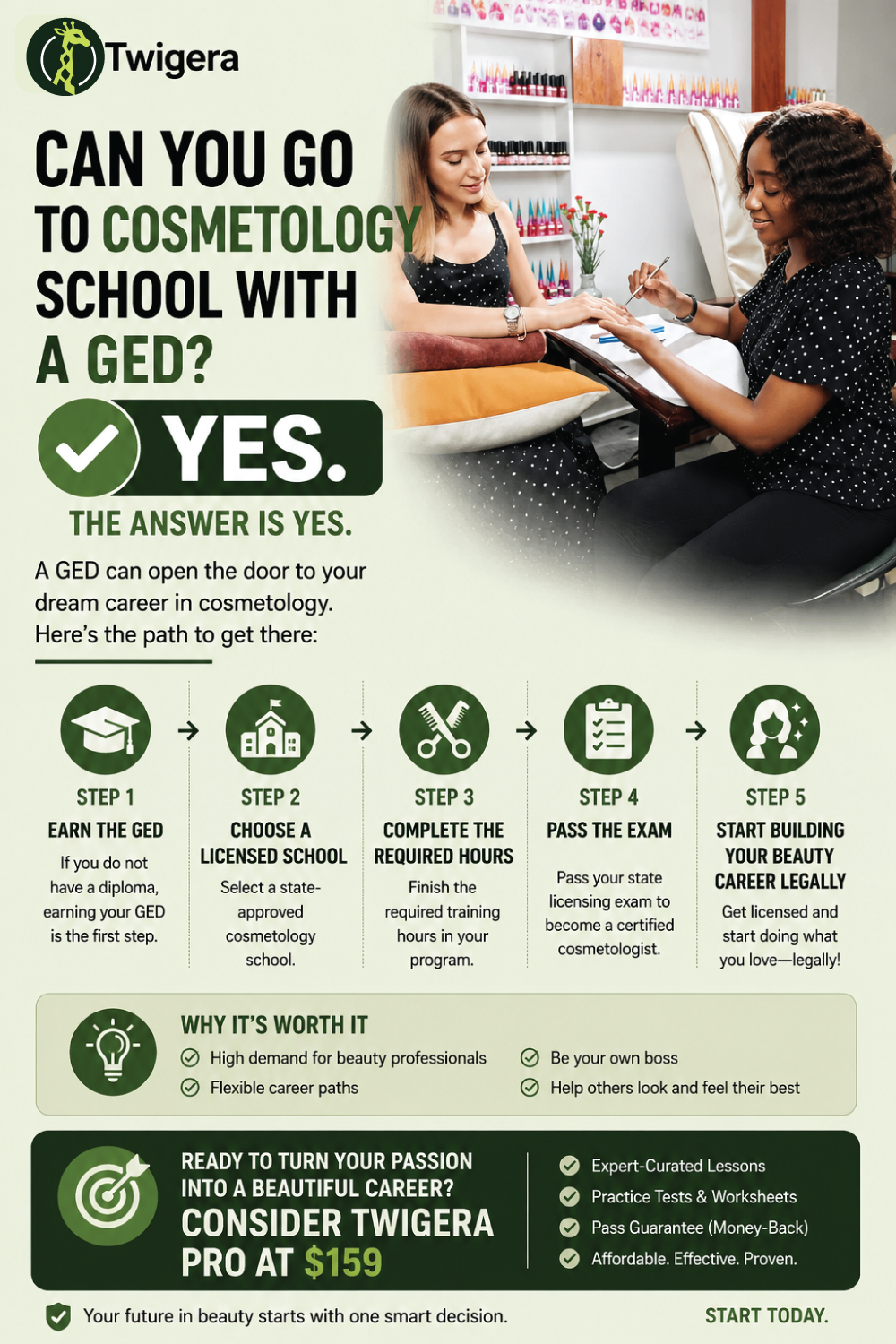
The practical path is clear: earn the GED if you do not have a diploma, choose a licensed school, complete the required hours, pass the exam, and start building your beauty career legally.
GED Requirements by Beauty Specialty
Beauty school is not one single path. The right program depends on the services you want to offer, how long you want to train, and what your state allows.
Cosmetology
Cosmetology is the broadest license. It can include hair, basic skin services, nails, sanitation, salon safety, and client care, depending on your state scope. Cosmetology programs often run from about 1,000 to 2,100 hours, depending on the state. If you are asking whether you can become a cosmetologist with a GED, the answer is usually yes when your school accepts high school equivalents.
Barbering
Barbering focuses on haircuts, clipper work, shaving, beard care, grooming, and shop sanitation. A barber school with a GED path is common because many barber schools treat the GED like a high school diploma. Check both the state board and the barber school. Many programs require a diploma, GED, or approved education level before licensing.
Esthetics
Esthetics focuses on skincare, facials, waxing, makeup, sanitation, and skin analysis. An esthetician school with a GED path can be shorter than full cosmetology. BLS says skincare specialists must complete a state-approved cosmetology or esthetician program and pass a state exam for licensure. If you search for esthetician training without a GED, do not stop at school admission — confirm exam eligibility with the state board.
Nails
A nail tech school with a GED route can be one of the fastest beauty paths. Nail programs usually cover manicures, pedicures, nail art, enhancements, infection control, sanitation, and client safety. Required hours typically range from 200 to 600, making this the shortest licensed beauty specialty.
Makeup
A makeup artist requirement depends on the state. Some makeup artists do not need a standalone license. Others need an esthetician or cosmetology license if the work includes regulated skin services, such as eyelash extensions, lash lifts, or chemical-based applications.
State-by-State Requirements to Check
State rules change, and beauty schools sometimes update admissions policies before older articles catch up. Use this table as a planning guide, then verify directly with your state board before enrolling.
State
GED rule to check
Cosmetology hours
Esthetician hours
Nail tech hours
California
Check school and board education route
1,000
600
400
Texas
Check TDLR and school rules
1,000
750
600
Florida
Check DBPR and school rules
1,200
260
240
New York
Check DOS school and license rules
1,000
600
250
Illinois
Check IDFPR rules
1,500
750
350
Ohio
Check state board rules
1,500
600
200
Georgia
Check state board rules
1,500
1,000
525
Pennsylvania
Check state board rules
1,250
300
200
California's Board of Barbering and Cosmetology says board-approved schools must meet minimum curriculum requirements and notes that cosmetology and barbering school minimums were reduced to 1,000 hours. Texas TDLR confirms a 1,000-hour cosmetology operator course, and Florida DBPR says cosmetology applicants must complete at least 1,200 educational hours.
The process feels easier when you follow it in order.
Step 1. Earn your GED
Start here if you did not finish high school. GED Testing Service says 145 is the passing score for each GED subject. Passing all four subjects gives you the credential most schools treat as a high school equivalent. If you need a structured plan, see our six-step GED guide.
Step 2. Choose your beauty path
Pick the license that matches your goal: cosmetology for the broadest training, barbering for grooming and shaving, esthetics for skincare, nails for the shortest path, or makeup if your state allows that route.
Step 3. Enroll in a state-approved school
Ask the school to confirm its approval status in writing. Then ask what license the program leads to, how many hours it includes, whether financial aid applies, and whether graduates qualify for the state board exam.
Step 4. Complete your hours
Training includes theory, sanitation, safety, client care, hands-on practice, and clinic work. You may attend full-time, part-time, evenings, or weekends.
Step 5. Pass the licensing exam
Many states use a written exam, a practical exam, or both. NIC candidate bulletins include information on written, practical, and written-practical beauty exams. Once you pass, you apply for your license and follow renewal rules set by your state.
Cost and Pell Grant Coverage
Beauty school cost depends on the school, location, program length, kit fees, books, supplies, exam fees, and schedule. Here are common cost ranges to expect.
Nail technician: $1,500 to $5,000 — shorter beauty entry path
Esthetician: $3,000 to $10,000 — skincare-focused learners
Barber: $5,000 to $15,000 — grooming and barber careers
Full cosmetology: $5,000 to $20,000 or more — broadest beauty license
GED holders may qualify for federal student aid when they attend an eligible school and meet FAFSA rules. For the 2025 to 2026 award year, Federal Student Aid lists the maximum Pell Grant scheduled award at $7,395. Award amounts depend on eligibility. Other funding options may include state workforce grants, school scholarships, federal loans, community college support, VA education benefits, and adult education partnerships. For more on financial aid, see colleges that accept the GED.
Salary and Career Options
Beauty income varies by specialty, location, schedule, tips, commission, client base, and business model. BLS reports a May 2024 median hourly wage of $16.95 for hairdressers, hairstylists, and cosmetologists. Barbers had a median hourly wage of $18.73. Skincare specialists, which include many estheticians, had a May 2024 median hourly wage of $19.98. Manicurists and pedicurists had a May 2024 median hourly wage of $16.66.
BLS also projects 5 percent growth for barbers, hairstylists, and cosmetologists from 2024 to 2034. Skincare specialists and manicurists or pedicurists are each projected at 7 percent growth over the same period.
Career paths after licensing
Your license can lead to more than one work model.
Salon employee — you work for a salon and may earn hourly pay, commission, tips, or a mix.
Booth renter — you rent space and manage your own clients.
Salon owner — you run the business, hire staff, and build a brand.
Freelance artist — you serve weddings, events, photoshoots, and mobile clients.
Educator or platform artist — you teach, demonstrate products, or train other beauty pros.
The license gives you the legal starting point. Skill, client care, consistency, and business habits shape the next stage.
Cosmetology Without a GED
Some schools may talk to students before GED completion. Some states may accept another education minimum for certain licenses. That does not mean you can ignore board rules.
If you are searching cosmetology paths without a GED, ask three questions.
Unlicensed beauty work can create legal, safety, and career problems. The safer path is to earn your GED first when your state or school requires it, then complete beauty school, pass the state exam, and apply for your license.
Cosmetology vs Trade School
Cosmetology is a career training path, but it is not the same as construction or technical trade school. Beauty careers are usually regulated through state cosmetology boards. You complete approved hours and pass a licensing exam before working legally in covered services. Construction trades may use apprenticeships, certificates, employer training, or state licenses.
The shared point is the GED. A GED can help you qualify for beauty school, trade school, financial aid, and career training programs. If you are comparing careers, start with the workday. Cosmetology is client-facing, creative, service-based, and detail-focused. Traditional trades are often tool-heavy, mechanical, technical, or jobsite-based. Both routes can lead to steady work — and a GED is widely equivalent to a high school diploma for both.
How Twigera Helps Future Beauty Professionals Earn a GED
If the GED is the step between you and beauty school, Twigera gives you an affordable online way to prepare. You are not studying for no reason — you are earning the credential that can help you apply to hair school, barber training, esthetician school, nail tech school, makeup training, or full cosmetology.
Twigera offers structured GED classes online, practice across all four GED subjects, and support you can use from home. That helps when you are balancing work, family, transportation, or a school deadline.
Twigera Pro is the strongest fit if beauty school is your next step. With Pro, you get 284 video lessons, more than 1,500 practice questions, a TI-30XS calculator mini-course, 12 months of access, and a money-back Pass Guarantee.
Bottom Line
A GED can help you move into cosmetology, barber, esthetician, nail tech, or makeup training. The exact rules depend on your state board and school, but a GED is widely accepted as a high school equivalent for beauty education and licensing paths.
Start with the practical checks. Confirm the school is approved. Ask whether your GED qualifies you for admission. Confirm the hours, cost, schedule, and exam pathway. If you still need the GED, handle that step first.
Frequently asked
Questions people ask.
Can you go to cosmetology school with a GED?
ShowHide
Yes. A GED is widely accepted as a high school equivalent for cosmetology school enrollment and state board licensing paths in all 50 US states. Always confirm with your state board and target school before applying — beauty licensing rules are set by state boards, and individual schools may add their own admission requirements.
Do you need a GED to be a cosmetologist?
ShowHide
Most states require a high school diploma, GED, or approved education level for licensing exam eligibility. Some states may accept a lower education level, such as completed 10th grade, for specific licenses. Check your state board before choosing a school so you do not pay tuition for a program that will not qualify you for the licensing exam.
Can you go to barber school with a GED?
ShowHide
Yes. Barber schools commonly accept a GED as a high school equivalent. You still need to complete your state required barber training hours (typically 800 to 1,500) and pass the licensing exam. Many state boards treat the GED and high school diploma identically for barber license eligibility.
Can you become an esthetician with a GED?
ShowHide
Yes. Many esthetician and skincare programs accept a GED. Esthetician school is often shorter than full cosmetology, with required hours typically ranging from 260 to 1,000 depending on the state. BLS reports skincare specialists earned a May 2024 median hourly wage of $19.98.
How long is cosmetology school?
ShowHide
Cosmetology school usually takes 1,000 to 2,100 training hours, depending on the state. Full-time programs may take 9 to 18 months. Part-time or evening programs can take longer. California, Texas, and Florida set their cosmetology minimums at 1,000, 1,000, and 1,200 hours respectively.
How much does cosmetology school cost with a GED?
ShowHide
Full cosmetology programs often cost $5,000 to $20,000 or more. Nail tech programs are usually lower, around $1,500 to $5,000. Esthetician programs typically range from $3,000 to $10,000. The maximum Pell Grant scheduled award for 2025-2026 is $7,395, which covers a significant portion of beauty school tuition for eligible learners.
Can you get Pell Grants for cosmetology school with a GED?
ShowHide
Yes, if the school and program are eligible and you meet FAFSA requirements. GED holders can qualify for Pell Grants at eligible cosmetology, barber, esthetician, or nail programs. Ask the school financial aid office to confirm Pell eligibility before enrolling — not every cosmetology school participates in federal student aid.
What is the fastest beauty license you can get with a GED?
ShowHide
Nail technician is often the fastest path. Many nail tech programs require about 200 to 600 hours of training. Full-time students may finish in 3 to 6 months. State rules decide the exact training time and exam requirements.
Can you become a cosmetologist without a GED?
ShowHide
Usually, no. Most licensed cosmetology paths require a high school diploma, GED, or approved education level before state board exam eligibility. A school may admit you into a support pathway without a GED, but the board may still require a credential before licensing. Verify both school admission rules and state licensing rules before enrolling.
How much do cosmetologists make?
ShowHide
BLS reports a May 2024 median hourly wage of $16.95 for hairdressers, hairstylists, and cosmetologists. Barbers earned a median of $18.73 per hour, skincare specialists $19.98 per hour, and manicurists or pedicurists $16.66 per hour. Income varies significantly by location, tips, commission, schedule, and business model.
Amara is the editor at Twigera. She came to publishing the long way — a decade teaching the GED in community colleges and adult-learning centers, where she watched students pass not on talent or time, but on the strength of a study plan they actually trusted. Now she shapes the guides students read here for the parent studying after a closing shift, the second-career welder, the grandmother finishing what she started forty years ago. Expect honest timelines, math made survivable, and study plans built around real life — not around a textbook's idea of one.
Enjoyed this?
Take the next step — start today.
Our online GED course includes every subject, a free 30-minute diagnostic, and a 7-day refund on every plan.